.svg)
.svg)

ARNO and “Nothing New” were part of the first “Circularium”
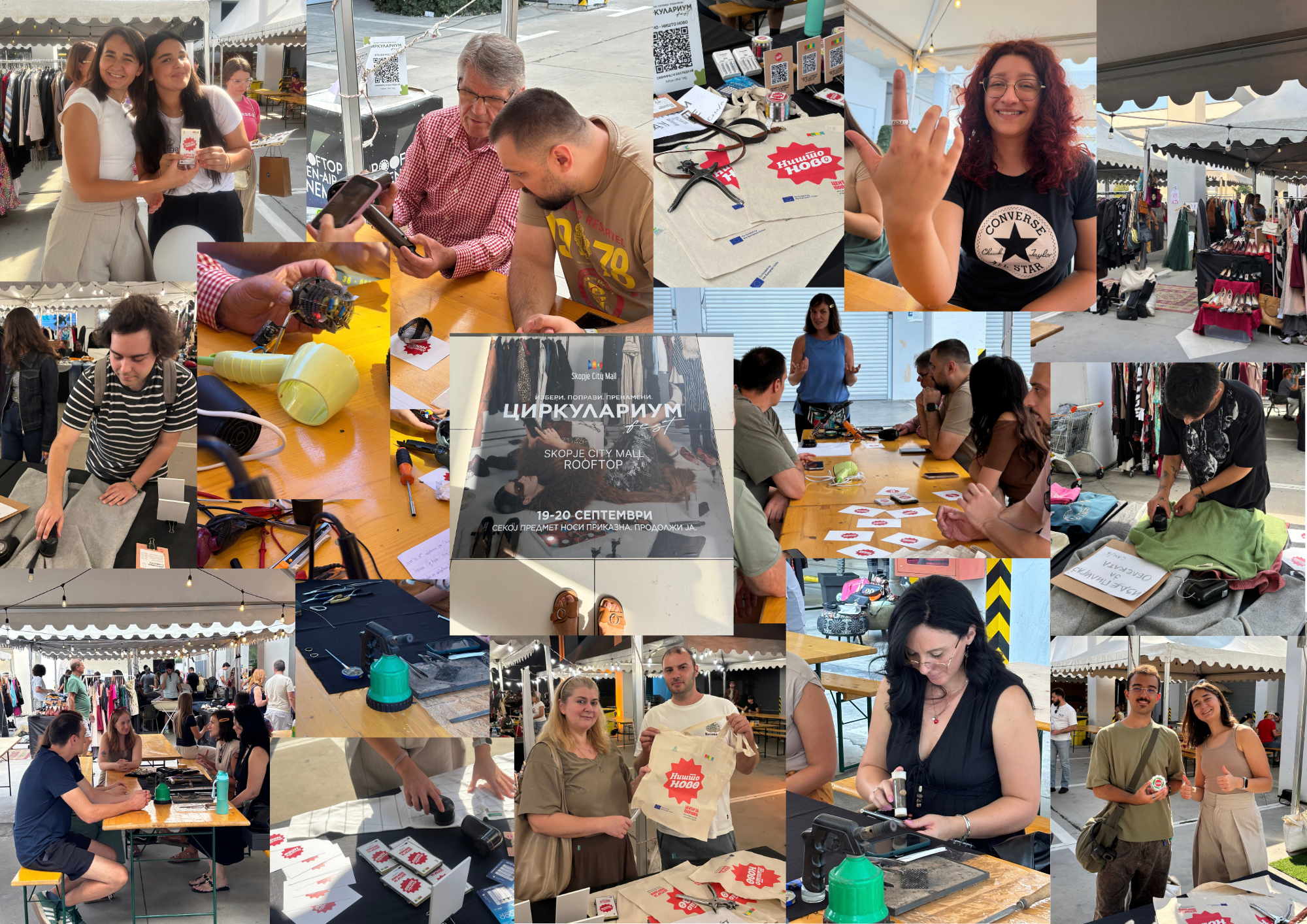
On September 19 and 20, 2026, ARNO participated in “Circularium”, an event organized by Skopje City Mall with a stand dedicated to our Repair Center “Nothing New”. Circulararium was held for the first time with the ambition to remain a platform for cooperation, exchange and connection for all of those who contribute to sustainability: individuals, designers, eco-businesses and brands, educational institutions, associations and organizations. Alongside ARNO and Nothing New’s stand, other organizations and businesses in the circular economy sector participated in “Circularium”: Loa Naturals—last year’s winners of the “Green Ideas” competition—who debuted a body cream made from used coffee grounds; SIEC Macedonia, featuring their well-known accessories made from discarded PVC banners and repurposed textiles; Irina Tosheva, showcasing handicrafts made by women from the Idrizovo Correctional Facility; Danche Serafimova’s eco-detergents; numerous second-hand shops; and more.
What did the “Nothing New” stand offer?
Visitors to our stand had the opportunity to learn about the center’s work to date, learn more about future plans and the announced IPA project, and also personally experience three practical activities:
- The first was “wax treatment of clothing”: a clothes waxer was used to remove lint from sweaters and blouses, restoring the fresh look of the clothes. The activity proved to be particularly useful for visitors who came from second-hand clothing stands, as many were wearing sweaters they had just bought from other stands and came directly to us to “freshen up” them that same day.
- The second activity was making a hole in a belt. An old belt that was missing a hole became practical to wear again – it was not about giving it a new look, but about making the item usable again instead of ending up in waste.
- The third activity was a quiz with questions in the field of circular economy and repairs, for which participants with correct answers received gifts: a set of rechargeable batteries, bags from “Nothing New”, a set of screwdrivers and a set of sewing threads. One of the questions – “What is the term ‘planned obsolescence’?” – left a particularly strong impression. The participants knew the term, but did not expect that it was actually practiced to such an extent – they expressed dissatisfaction after learning that certain products are intentionally made to last shorter, so that the buyer buys the same product again. Older generations in particular told us that in today’s era of consumerism, the quality and longevity of a product are becoming a rarity, compared to the time when appliances were repaired and used for decades. The purpose of this activity was to improve knowledge about the circular economy, but also to see how far citizens are in knowledge of these topics.
Practical workshops for acquiring skills
Before the main event, interested citizens had the opportunity to register for two specialized workshops:
Jewelry repair workshop (day 1): Under the guidance of filigree artist Katarina Doda, visitors learned how to repair their rings that had been forgotten in drawers for years. With patience and care, some of the participants straightened their rings themselves on a special cone. Although she started with modest expectations, Katerina was delighted by the energy she felt in the attendees. She is already thinking about what details she will focus on in the next workshops.
Hairdryer diagnostics and repair workshop (day 2): Master craftsmen Momčilo showed the attendees that most of the appliances that end up in waste have simple defects (most often accumulated dirt). Despite the fact that some of the hair dryers brought in were irreparable or unprofitable to repair, at the end of the workshop, two hair dryers were successfully repaired.
Impressions from the field:
“Many of the visitors did not know that recycling is at the bottom of the waste management hierarchy, and before it came reduction, reuse and repair. The younger generations were especially curious to learn more, and many shared that they buy second-hand clothes. I had a great time, but next time something I would definitely change in the quiz is to make the questions simpler, it was difficult to explain about the repairability index and the right to repair as an EU policy.” – Angela (ARNO)
“This is my first time officially attending an ARNO event. I found the preparations interesting, I had to figure out how to make holes in belts to show people. I also assisted at the hair dryer workshop, and the biggest impression I had was the fact that hair dryers are intentionally made with different mechanisms to make them harder to open and repair, which confirms the challenges that today’s consumerism brings. All in all, the event was a nice experience for me and I met wonderful people. – Christian (ARNO)
“For me, the event was a great success. There was a great energy, wonderful people, and the fact that it was held in a shopping mall gave us access to a new audience, not just our circle of people who are already aware of consumerism and the need for repairs. I was worried about how we would conduct our workshops outside of the space and all the tools that we have in Kisela Voda, but it turned out great. Our instructors also shared personal stories, the participants were adorable. There was a couple of guys and girls, very capable, who opened their hair dryer themselves, another participant’s hair dryer, and I think that at home they have a hobby of repairing it.” – Irina (ARNO)
,,The hair dryer is especially dear to me because it was a gift from my mother, but over time it became only partially functional. I am overjoyed that thanks to the dedication of the master craftsman, it has come back to life, and the whole experience was made even more special by the positive energy of the entire team.” – Zimere (Participant of the workshop on diagnostics and repair of hair dryers)
“Circularium” once again confirmed to us that the culture of repair is not something of the past, but a habit that can be brought back, if there is space, tools and people who will show it. Therefore, the next time something breaks, ask yourself: Can it be fixed? Or, how can I make this item last longer?
A big thank you to Skopje City Mall for the invitation, to Katarina and Momcilo for their expertise and to all the citizens who stopped by our stand. Follow the social networks for the next activities of “Nothing New”!